
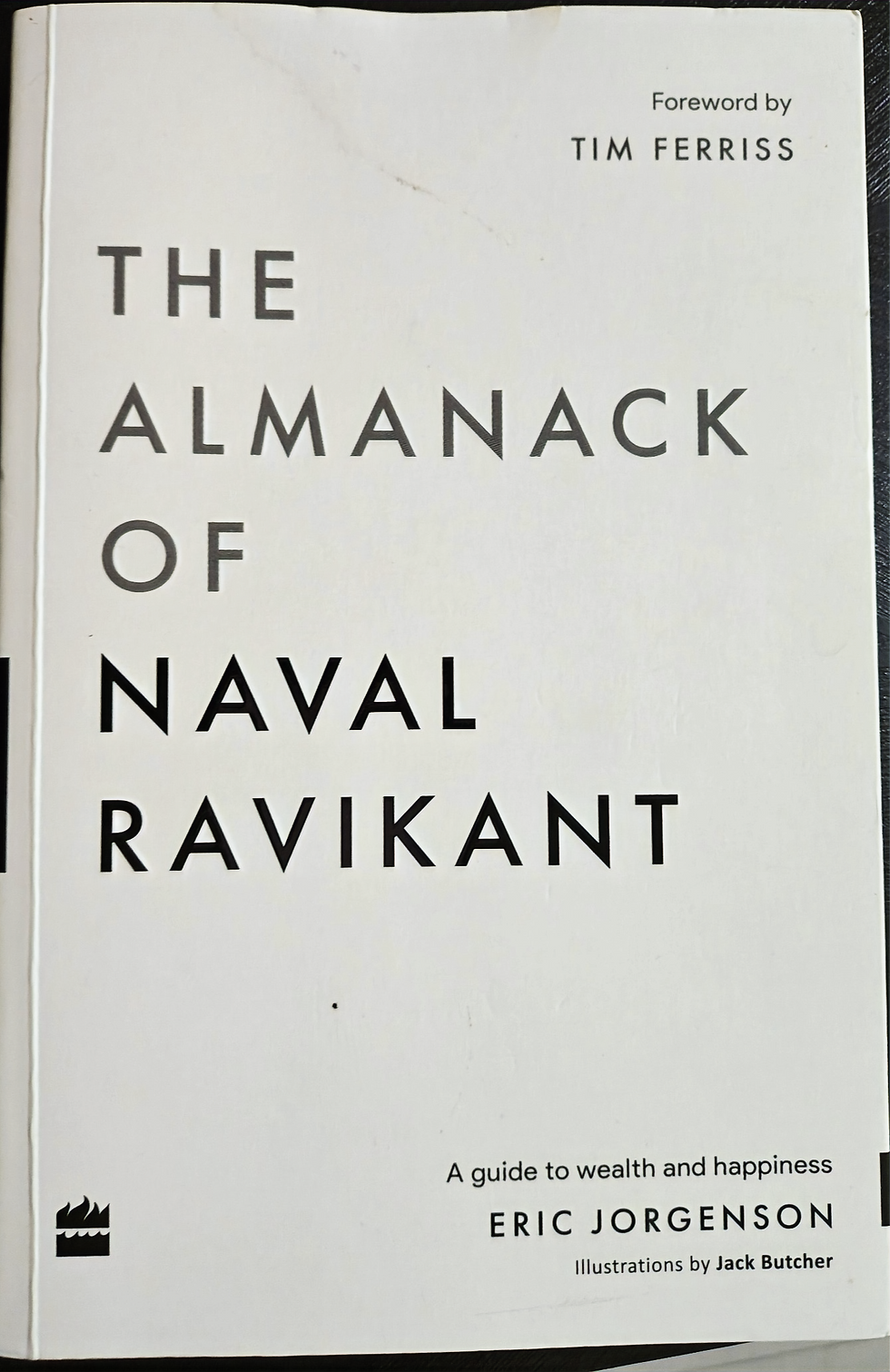
Notes from The Almanack of Naval Ravikant

This read was long overdue.
A few pages into The Almanack of Naval Ravikant, I stopped reading and started taking notes. Some of them just to remember. Others to come back to.
The book is full of thoughts on wealth, leverage, judgment, and happiness.
But to me, it’s a book about a bunch of first principles. Here are a few takeaways that I keep circling back to. The ones in code blocks are the ones that resonate the most with me.
Wealth is having assets that earn while you sleep.
You're not going to get rich by renting your time. You must own equity - a piece of business - to gain your financial freedom.
You will get rich by giving society what it wants but does not know yet how to get it. At scale.
Most of life is a search for who and what needs you the most
The best jobs are neither decreed nor degreed. They are creative expressions of continuous learners in free markets.
Be a perpetual learner. You have to know how to learn anything you want to learn. If there is anything you cannot understand, you have to dig down and say "what is the foundation required for me to learn this."
You do need to be deep in something because otherwise you'll be a mile wide and an inch deep and you won't get what you want out of life. You can only achieve mastery in one or two things. It's usually things you're obsessed about.
All the returns in life; whether in wealth, relationships, or knowledge, come from compound interest.
Be thoughtful about what you do.
"Following your genuine intellectual curiosity is a better foundation for a career than following whatever is making money right now."
"Follow your intellectual curiosity more than whatever is "hot" right now."
"If it entertains you now but will bore you someday, it's a distraction. Keep looking."
If they can train you to do it, then eventually they will train a computer to do it. You want to know how to do something other people don't know how to do at the time period when those skills are in demand. What you want in life is to be in control of your time.
Each level has increasing leverage, increasing accountability, increasingly specific knowledge.
Avoid risk of ruin.
Take rationally optimistic bets with big upsides.
I'd love to be paid purely for my judgement, not for any work. I want a robot, capital, or computer to do the work, but I want to be paid for my judgement. Demonstrated judgement - credibility around the judgement is so critical.
Always factor time into every decision. How much time does it take?
Play stupid games, win stupid prizes.
Spend more time making big decisions.
Where you live.
Who you're with.
What you do
Figure out what you're good at, and start helping other people with it. Give it away. Pay it forward.
Find work that feels like play.
Be authentic
Find the thing you know how to do better than anybody.
You know how to do it better because you love it, and no one can compete with you.
How to map that to what society actually wants.
Ways to get lucky
Hope luck finds you
Hustle until you stumble into it.
Prepare the mind and be sensitive to chances others miss.
Become the best at what you do. Refine what you do until this is true. Opportunity will seek you out. Luck becomes your destiny
Facebook redesigns. Twitter redesigns. Personalities, careers, and teams also need redesigns. There are no permanent solutions in a dynamic system. "Praise specifically, criticize generally." Warren Buffet
If you can't decide, the answer is no. Simple heuristic: If you're evenly split on a difficult decision, take the path more painful in the short term. Read a lot -- just read.
Reading science, math, and philosophy one hour per day will likely put you at the upper echelon of human success within seven years.
To think clearly, understand the basics.
When solving problems, the older the problem, the older the solution.
The world just reflects your own feelings back at you. Reality is neutral. Reality has no judgements. How you chose to interpret something is up to you. You have that choice.
Real happiness is going to come from acceptance.
"You are a combination of your habits and the people who you spend the most time with."
We don't always get what we want, but sometimes what is happening is for the best. The sooner you can accept it as a reality, the sooner you can adapt to it. Hard choices → Easy life
Easy choices → Hard life
"We evolved for scarcity but live in abundance." The important thing is to do something every day. It doesn't matter what it is. The best workout for you is one you're excited enough to do everyday.
Most of our suffering comes from avoidance.
I am more than my monkey mind.
When you have inspiration, act on it right then and there.
"Set up systems, not goals." -- Scott AdamsThere is no endpoint to self-awareness and self-discovery.
Reading Naval felt like an easy read, discovering a few new principles, and more like returning to ones I’ve always believed in, but needed someone with authority to say it again.
If I had to distill what this book nudged me toward, it’s this:
Live with intention.
Keep learning/reading. Not for anyone, not for money, but because it keeps you alive inside.
Comments